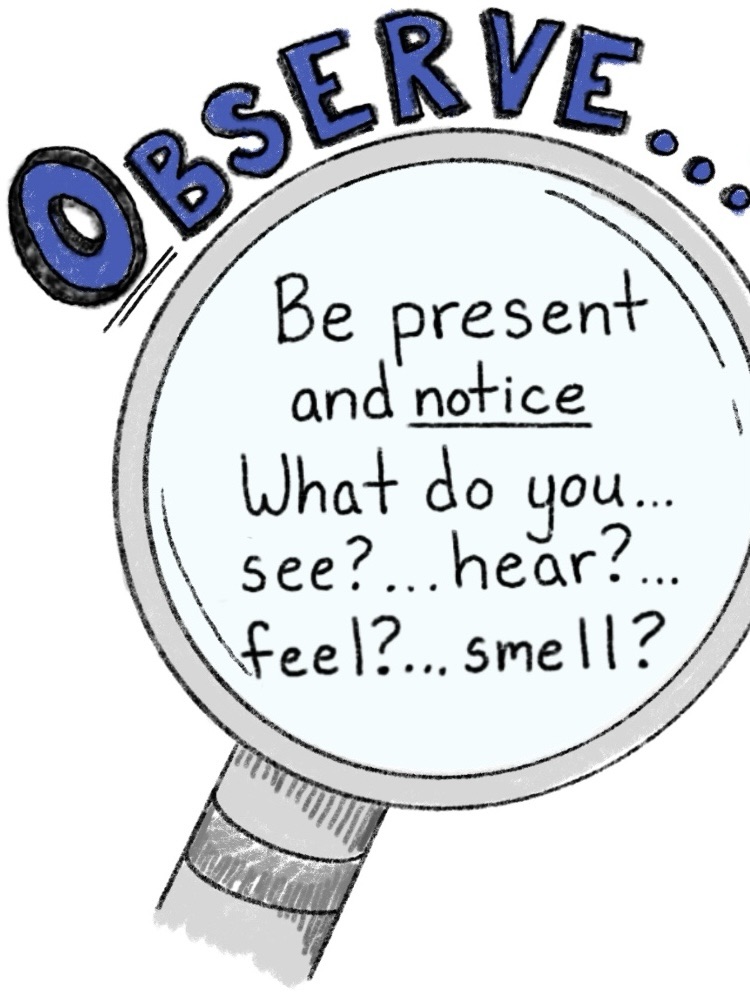
Hello and welcome back to the series on Nature Journaling! Today we are going to dive into the practice of Noticing.

5 Senses – an activity
Go outside…or even just head somewhere different, like the grocery store. Pause and take a breathe in…
- What do you see? – Look at the big things- the trees, waters, the sky. Look at the small things – mushrooms, mosses, and dew. Then look to the things in between them. If it feels safe to do so, close your eyes and listen.
- What do you hear? – Birds singing? Or perhaps someone walking or riding a bike along a nearby path? What is the lightest sound you can hear? Is it the rustle of the leaves in the wind or maybe the burble of water in a distant stream?
- What do you smell? – The smells in nature can be an intriguing experience. In spring, the air can be rich with the scent of blooming flowers and it can be interesting to notice when different blooms are stronger. I also love going out after rainfall and enjoying petrichor (which is one of my favorite words) – the scent of the earth after a storm. Even in the cooler months, conifers continue to release oils which science shows have a calming effect.
- What do you feel? – Obviously don’t touch plants if you’re not sure if they are safe. Plants like Queen Anne’s Lace look remarkably similar to Poison Hemlock, which can be very irritating to skin. But feeling the moss or soil on our fingers can be fun. Or even the way the land feels under our feet as we walk across different surfaces.
- What do you taste? – Again unless you are a knowledgeable forager, be cautious when collecting or eating plants found in your neighborhood. If you are interested in learning more, I recommend seeking out local courses that will help you identify safe foods to forage in your nature nooks. But I often enjoy bringing water and a snack when going out on a walk. Notice how they feel and taste. Is it different from eating or drinking in different settings?
As you notice these aspects of the world around you, record them in your journal. Draw a picture or icon that helps capture your noticings. Or if you can’t draw it – use words or numbers to help describe it. I think sometimes playing with how to describe what we encounter can be fun and way to challenge ourselves as nature journalers.

N is for Notice
This is one of the most unexpected outcomes of Nature Journaling. The more I journal, the more I go outside, and the more I notice. I have had students in my nature journal classes report this as well – that once they notice something in a sit spot or nature nook, the more they notice around them. A popular one is showing students mushrooms. Once you notice one, it is often easier to see more and more of them sprouting up around you.
Notice is also one of the key concepts of the practice of INIWIRMO introduced by John Muir Laws (who I HIGHLY recommend learning from). This stands for I Notice, I Wonder, and It Reminds Me Of, which are helpful prompts for starting a nature journal page and practice. Check out some of the other posts in this series for more fun strategies to play with in your own nature journal.
Until next time, happy exploring!
Kirsten, the NW Naturalist


Leave a Reply